

Table of Contents
How to Achieve Your Life Goals with $100K Savings
You’ve finally done it. You’ve worked hard, practised financial discipline, and have finally hit the elusive six-figure mark in your savings account. Congratulations!
After a small celebratory dance, grab a seat, and let’s find out how we can turn this $100,000 into your retirement savings, money for your new home, or maybe your children’s education fund. The key is to do this in a safe, smart and sustainable way, and this starts with a better understanding of the options available to you.
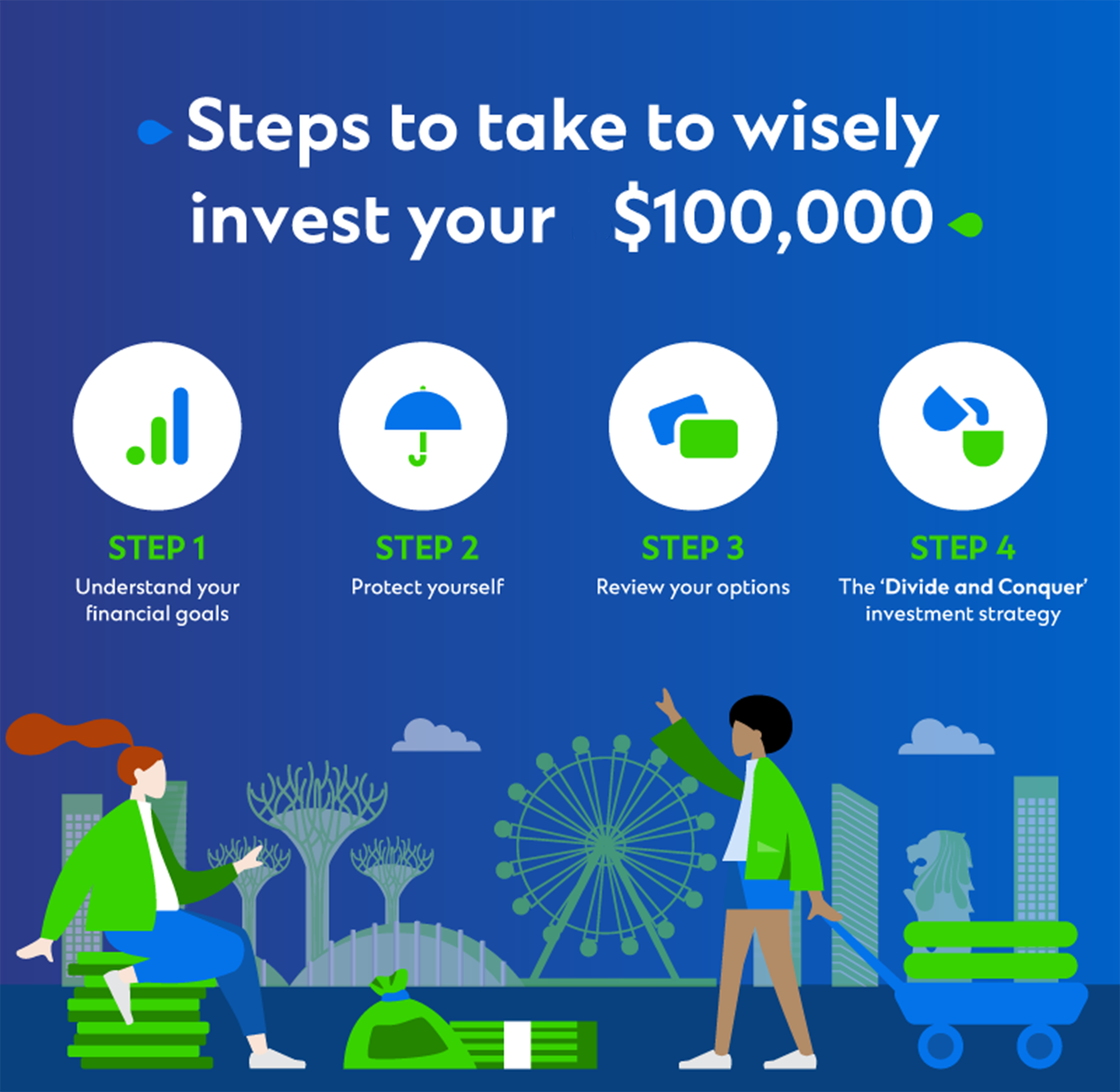
Here are the steps you should take to wisely invest your $100,000:
Let’s dive right in!
Step 1: Understand Your Financial Goals
Before we go further, you will need to understand why you want to invest in the first place. What kind of goals are you looking to achieve? What timeframe are you looking at? How audacious or risky should your targets be?
Here are some common examples of financial goals to get you thinking:
- Retirement planning
- Buying your first home
- Providing for elderly parents
- Setting up your child’s education fund
- Protecting your wealth from inflation
Your goal will motivate you to keep growing your nest egg, as well as determine the strategy to take when investing your hard-earned money.
Step 2: Protect Yourself
Protecting yourself from downside financial risks is important when trying to secure your financial goals. The last thing you would want is for a small hiccup to derail your plans. However, there’s no need to get into a big fuss about it. Here are some tips that can add some guardrails to life’s curveballs.
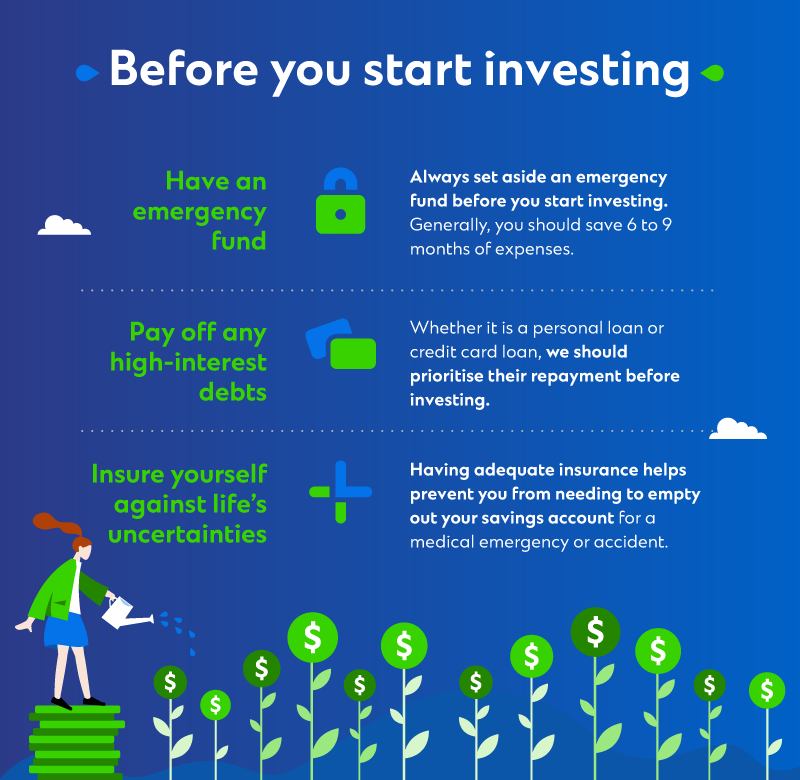
1. Ensure you have an emergency fund
Always set aside an emergency fund before you start investing. These funds can be used to cover situations such as unexpected repair bills or a sudden loss of income. Generally, you should save 6 to 9 months of expenses – check out our guide to learn more.
2. Pay off any high-interest debts
Taking on debt may have enabled you to improve your quality of life in the immediate term, but holding on to debt, especially high-interest debts, is a recipe for financial disaster. Whether it is a personal loan or credit card loan, we should prioritise their repayment before investing. Compounding interests should benefit you instead of becoming a burden; high-interest debt can quickly snowball out of control.
3. Insure yourself against life’s uncertainties
You may not need the most expensive and premium insurance plan, but having adequate insurance helps prevent you from needing to empty out your savings account for a medical emergency or accident. Look into these policies to safeguard you and your family from potential financial difficulties:
- Critical illness coverage
- Hospitalisation insurance
- Life insurance
Step 3: Review Your Options
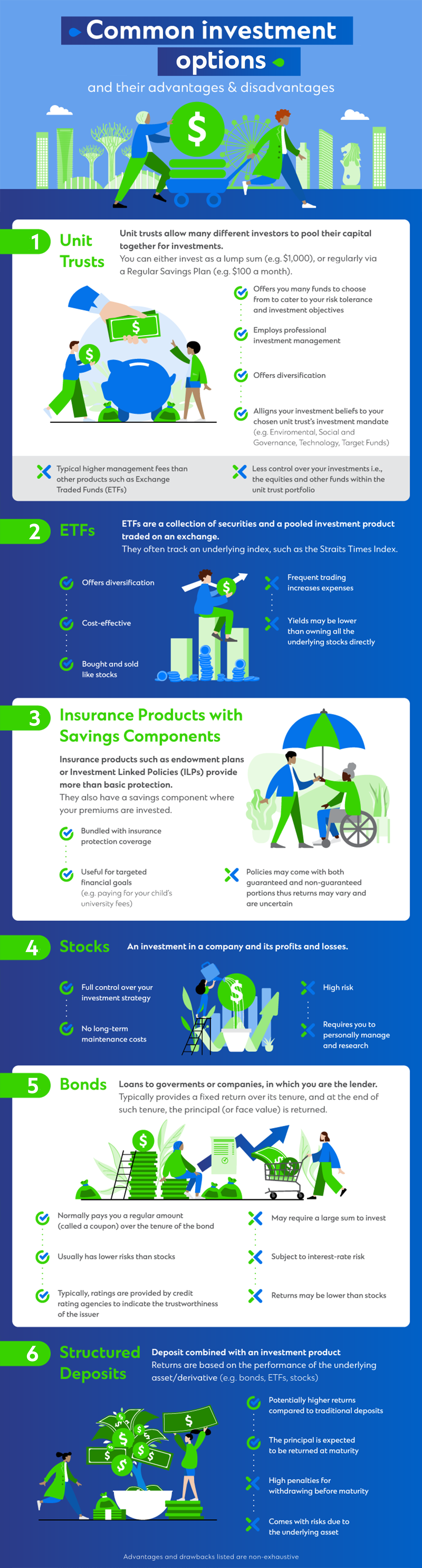
If you’re not already savvy to the many investment options available to you in Singapore, then it’s a great time to review what’s out there. While not an exhaustive list of options, these would act as a good starting point to conduct your investment research.
Of course, if all of this looks like Greek to you, speak with a financial adviser who can help better define suitable options for you.
Step 4: The ‘Divide and Conquer’ Investment Strategy
As we saw in the table above, each investment option comes with its own pros that are appealing in their own way, and cons which may make you think twice. What options you choose will depend on a variety of factors including your financial goals and your risk appetite. An investor’s goal is generally to meet the level of expected returns with minimal risks.
What’s the best way for you to achieve a well-balanced portfolio that can spread out your risks and offer you a better chance of stability during a volatile economy? Diversification. Diversifying your portfolio means having a variety of instruments that would perform dissimilarly in different market conditions – this aims to maximise your returns or minimise your losses at any given time.
One way of allocating your assets is using the Bond-to-Stock ratio. A common one being the 100 Minus Age rule. This rule comes with a sliding allocation scale, where your allocation in bonds is equivalent to your age, and while your allocation in stocks is 100 minus your age.
What if I don’t have $100,000 to invest today?
Whether you have $100,000 or just $100 to spare, these strategies can be applied to help take you one step closer to achieving your financial goals. With unit trusts for example, you can also consider setting up a Regular Savings Plan (RSP) to invest a fixed amount of funds every month to grow your wealth quicker. And remember, the best time to begin is today.
Rinse and Repeat
However you choose to invest your money, be sure to review and optimise your financial strategies on a regular basis. If you need help with your investments, do check in with a financial adviser, who will be able to provide you with the advice and information you require. If you’re fired up and ready to go, check out what Standard Chartered has to offer.
References


Your feedback is valuable to us. Did you find this article helpful?
This article is for general information only and it does not constitute an offer, recommendation or solicitation of an offer to enter into any transaction or adopt any hedging, trading or investment strategy, in relation to any securities or other financial instruments. This article has not been prepared for any particular person or class of persons and does not constitute and should not be construed as investment advice or an investment recommendation. It has been prepared without regard to the specific investment objectives, financial situation or particular needs of any person or class of persons. You should seek advice from a licensed or an exempt financial adviser on the suitability of a product for you, taking into account these factors before making a commitment to purchase any product or invest in an investment. In the event that you choose not to seek advice from a licensed or an exempt financial adviser, you should carefully consider whether the product or service described herein is suitable for you.
You are fully responsible for your investment decision, including whether the investment is suitable for you. The products/services involved are not principal-protected and you may lose all or part of your original investment amount.
Standard Chartered Bank (Singapore) Limited will not accept any responsibility or liability of any kind, with respect to the accuracy or completeness of information in this article.
Deposit Insurance Scheme
Singapore dollar deposits of non-bank depositors are insured by the Singapore Deposit Insurance Corporation, for up to S$100,000 in aggregate per depositor per Scheme member by law. For clarity, these investment products are not deposits and do not qualify as an insured deposit under the Singapore Deposit Insurance and Policy Owners’ Protection Schemes Act 2011. Foreign currency deposits, dual currency investments, structured deposits and other investment products are not insured.
The information stated in this article is accurate as at the date of publication.