

Key takeaways:
- Car insurance is legally required in Singapore, but choosing the right level of coverage can also help protect you from unexpected repair, replacement and liability costs
- Consistent claim-free driving can steadily lower renewal premiums through the no-claim discount (or NCD), while being underinsured can mean significant out-of-pocket and legal costs after an accident
- Electric vehicles (or EV) owners and expats face some different considerations, from battery repair costs to documentation requirements. Double-check before choosing a policy
Table of Contents
- How does car insurance work in Singapore?
- Eligibility for car insurance
- What’s covered vs what’s not covered
- Important terms to compare when purchasing car insurance
- Understanding no-claim discount (NCD)
- The real cost of being underinsured
- Special considerations: Electric Vehicle (EV) owners and expats
- Car insurance available through Standard Chartered
- FAQs about car insurance in Singapore
Owning a car in Singapore comes with a legal obligation: car insurance is mandatory under the Motor Vehicles (Third-Party Risks and Compensation) Act. Without valid insurance in force, a vehicle cannot be registered or used on Singapore roads.
Beyond the legal requirement, car insurance serves as a financial safeguard. Accidents, theft, and unexpected repairs can be costly, and the right coverage can help protect drivers from bearing these costs alone.
How does car insurance work in Singapore?
Car insurance transfers part of the financial risk from the driver to an insurer in exchange for a premium. When registering a vehicle with the Land Transport Authority (LTA), drivers must provide a valid certificate of insurance as proof that coverage is in place.
Premiums are calculated based on several factors, including the driver’s age and driving experience, the vehicle’s make and value, and past claims history. Insurers may also consider how the vehicle is used, such as for personal or business purposes. When an accident or covered event occurs, the policyholder submits a claim to the insurer, who assesses the incident against the policy terms before processing a payout or arranging repairs.
What affects the premium?
Insurers commonly consider:
- The car’s make, model, age, engine capacity and value
- The driver’s age, experience and claims history
- Intended use, such as private use or private-hire driving
- The driver’s No Claim Discount (NCD)
- The policy excess
- Whether repairs are restricted to an authorised workshop
- Additional named or unnamed drivers
- Vehicle modifications
A higher excess may reduce the premium, but you will pay more when making an eligible own-damage claim.
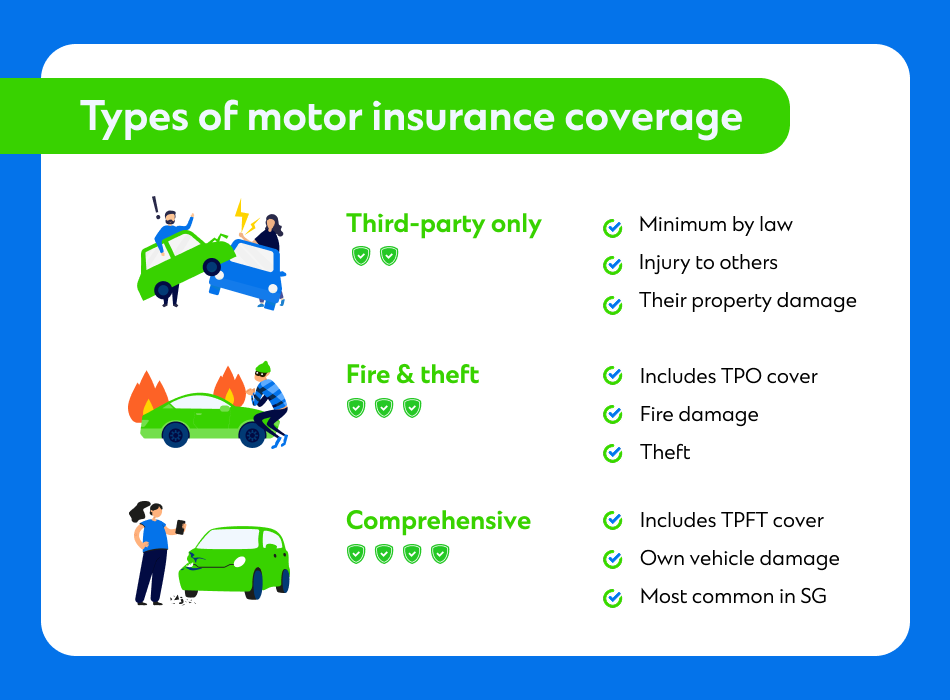
Types of motor insurance coverage
Motor insurance in Singapore generally falls into three categories, each offering a different level of protection:
- Third-Party Only (TPO): Covers death, injury, or property damage to third parties. This is the minimum legal requirement.
- Third-Party, Fire & Theft (TPFT): Includes TPO coverage, plus protection for the policyholder’s own vehicle against fire damage or theft.
- Comprehensive: Covers TPFT benefits, plus damage to the policyholder’s own vehicle from accidents, regardless of fault. This is the most common type of coverage chosen by drivers in Singapore.
Choosing a suitable coverage plan depends on the vehicle’s value, how it’s used, and the driver’s risk tolerance.
Eligibility for car insurance
To apply for car insurance in Singapore, drivers will need a valid driving licence and a registered vehicle. Insurers typically assess age, driving experience, and claims history when determining eligibility and premiums, with most requiring a minimum driving experience period.
For expatriates, eligibility depends on residency status, licence type and insurer requirements. Some foreign drivers may need to convert an overseas licence to a Singapore driving licence after meeting local residency rules. To ensure you have the latest requirements, check with the Singapore Traffic Police before applying, as rules can vary by visa type and length of stay.
What’s covered vs what’s not covered
Understanding what is and isn’t covered can help you avoid unexpected out-of-pocket expenses and reduce the likelihood of surprises when making a claim.
What’s covered (depending on plan type):
- Accidental damage to your vehicle
- Third-party liability for injury or property damage
- Fire damage and theft (under TPFT and Comprehensive plans)
Common exclusions:
- Normal wear and tear
- Damage caused by unauthorised drivers
- Incidents involving driving under the influence of alcohol or drugs
- Damage related to undisclosed or unapproved vehicle modifications
Coverage details vary by insurer and policy. Review the policy wording carefully, especially the exclusions section, before purchasing. If anything is unclear, contacting the insurer directly for clarification can help avoid surprises during claim filings.
Important terms to compare when purchasing car insurance
- Excess: The amount you pay towards a claim
- NCD: A premium discount earned through claim-free years; some insurers recognise increases of 10 percentage points per claim-free year, up to 50%
- Market value versus agreed value: How the insurer calculates a total-loss payout
- Authorised workshop versus any workshop: Whether repairs are limited to the insurer’s approved workshops or can be carried out at a workshop of your choice.
- Named-driver restrictions: May impose extra excesses for young, inexperienced or unnamed drivers
- Add-ons: May include windscreen cover, roadside assistance, flood protection, loss-of-use benefits or NCD protection
Understanding no-claim discount (NCD)
The NCD rewards drivers for staying claim-free. Under the framework set by the General Insurance Association (GIA) of Singapore, drivers earn an increasing discount on their premium for each consecutive year without a claim, up to a maximum of 50%.
Making a claim may reduce or reset NCD, depending on the policy terms, which is why some insurers offer NCD protection as an optional add-on. This allows one claim within the policy year without losing the discount, though protected NCD may not transfer to another insurer.
NCD is tied to the driver rather than the vehicle and can be transferred when switching insurers or buying a new car, subject to insurer rules and no lapse in coverage.
The real cost of being underinsured
Choosing minimal coverage to save on premiums can be a costly trade-off. If a policy only covers third-party liability, the policyholder is responsible for repairing or replacing their own vehicle after an at-fault accident, which can amount to a significant out-of-pocket expense.
Underinsurance can also create liability risk. In serious accidents involving injury or extensive property damage, claims and related costs can exceed what a policy covers, leaving the driver personally liable for the shortfall, including potential legal costs.
Repair and claim costs also tend to rise over time, which means a coverage level that felt sufficient at purchase may no longer match current replacement or repair costs. Reviewing coverage periodically helps ensure protection keeps pace with these changes.
Special considerations: Electric Vehicle (EV) owners and expats
For EV owners: As EV ownership grows in Singapore, insurance needs can differ from those of conventional vehicles. When comparing policies, look beyond premiums and check whether battery-related repairs, charging equipment and workshop access are covered.
For expats: Documentation requirements can differ from those for local drivers, particularly around licence validity and driving history. Insurers may request additional proof, such as an overseas driving record or residency status. Confirm the required documents with the insurer before applying to avoid delays or a declined application.
Car insurance available through Standard Chartered
Understanding coverage types and eligibility is a useful starting point, but choosing a provider matters too. Standard Chartered offers access to Allianz Motor Protect, with an Electric Motor Protect variant for EV owners, across Third-Party Only, Third-Party Fire & Theft, and Comprehensive tiers.
For those considering Comprehensive cover, features include roadside assistance and a replacement vehicle option for newer cars written off within two years. EV owners are additionally covered for electric components and charging-related risks.
The right car insurance can provide peace of mind and protection against unexpected costs. Learn more about Allianz Motor Protect or access the Invest & Insure feature on the SC Mobile App to get started.
FAQs about car insurance in Singapore
1. Is car insurance mandatory in Singapore?
Car insurance is mandatory in Singapore and drivers must provide the Land Transport Authority (LTA) with a valid Certificate of Insurance when registering a vehicle. Under the Motor Vehicles (Third-Party Risks and Compensation) Act, a vehicle cannot be registered or driven in Singapore without valid insurance coverage.
2. How does the no-claim discount work for car insurance in Singapore?
A no-claim discount reduces a driver’s premium for each consecutive claim-free year, up to a maximum discount of 50%. Drivers earn a growing discount on their premium for each consecutive claim-free year and making a claim can reduce or reset this discount, depending on the insurer’s terms. Optional NCD protection may permit one claim during the policy year without losing the discount.
3. Can expats in Singapore buy car insurance easily?
Yes, though documentation requirements can differ from those for local drivers. Insurers may ask for a valid driving licence, proof of residency status, and driving history, and new drivers may face higher premiums until they build a claims record.
4. What should EV owners look for when comparing car insurance in Singapore?
EV owners should check whether the policy covers battery damage, charging equipment and access to workshops equipped for electric vehicles as EV policies often account for higher battery and component repair costs, along with the need for specialised workshops, which can affect how premiums are priced compared to petrol vehicles.
5. What happens if I’m underinsured and get into an accident?
The policyholder may need to cover repair, or replacement costs out of pocket and could be personally liable for third-party claims that exceed the policy’s coverage limits.
Your feedback is valuable to us. Did you find this article helpful?
This article is for general information only and it does not constitute an offer, recommendation or solicitation of an offer to enter into any transaction or adopt any hedging, trading or investment strategy, in relation to any securities or other financial instruments. This article has not been prepared for any particular person or class of persons and does not constitute and should not be construed as investment advice or an investment recommendation. It has been prepared without regard to the specific investment objectives, financial situation or particular needs of any person or class of persons. You should seek advice from a licensed or an exempt financial adviser on the suitability of a product for you, taking into account these factors before making a commitment to purchase any product or invest in an investment. In the event that you choose not to seek advice from a licensed or an exempt financial adviser, you should carefully consider whether the product or service described herein is suitable for you.
You are fully responsible for your investment decision, including whether the investment is suitable for you. The products/services involved are not principal-protected and you may lose all or part of your original investment amount.
Standard Chartered Bank (Singapore) Limited will not accept any responsibility or liability of any kind, with respect to the accuracy or completeness of information in this article.
Deposit Insurance Scheme
Singapore dollar deposits of non-bank depositors are insured by the Singapore Deposit Insurance Corporation, for up to S$100,000 in aggregate per depositor per Scheme member by law. For clarity, these investment products are not deposits and do not qualify as an insured deposit under the Singapore Deposit Insurance and Policy Owners’ Protection Schemes Act 2011. Foreign currency deposits, dual currency investments, structured deposits and other investment products are not insured.
The information stated in this article is accurate as at the date of publication.