
Table of Contents
With the Fed’s April meeting now behind us and with Jerome “Jay” Powell’s term as Fed Chair drawing to a close, I’m reminded of Wilson Phillip’s 1990 song, “Hold On”. As the chorus goes:
If you hold on for one more day… things will go your way. Hold on for one more day!
Besides keeping rates on hold, it appears Jay Powell has also decided to ‘hold on’… to his Board seat at the Fed. Powell recently pointed to the Trump administration’s legal threats against him and the Fed as unprecedented, expressing grave concern – “I worry that these attacks are battering the institution and putting at risk the thing that really matters to the public, which is the ability to conduct monetary policies without taking into consideration political factors.”
Powell’s decision is a significant departure from the norm. By tradition, most Fed Chairs leave the Board when their terms end (think Greenspan, Bernanke or Yellen). However, by staying on after his term as Chair ends, Powell is following the precedent set by Marriner Eccles – who, after his term as Fed Chair ended in 1948, stayed on the Board to ensure policy continuity through a volatile macroeconomic regime. One could say that with inflation not fully subdued, term premia reawakened and fiscal-monetary tensions resurfacing, Powell feels a similar institutional incentive to remain at the Fed in some capacity.
Of course, the market implications are non-trivial. The incoming Fed Chair, Kevin Warsh – now very likely to be confirmed by the Senate – could face an influential counterweight as he seeks to build consensus within the Federal Open Market Committee for rate cuts premised on the idea that AI will meaningfully boost US productivity, dampen inflation and weigh on labour demand.
But first, who was Marriner Eccles?
Marriner Eccles served as Fed Chair from 1934 to 1948, but instead of stepping away from the central bank completely after his term ended, Eccles chose to remain as a governor until 1951. The reason? It all boils down to Fed independence.
During World War II, at the Treasury’s direction, the Fed maintained caps on Treasury yields across the curve to finance the war cheaply – roughly 0.625% on T-bills and 2.5% on long bonds. By 1948, with the war long over, those ‘yield caps’ still constrained policy just as inflation pressures were building. While still a Fed governor, Eccles pushed the Treasury and the then-Fed Chair Thomas McCabe to end the caps. The result was the 1951 Fed-Treasury Accord, which effectively restored the Fed’s operational independence.
Powell faces Eccles-era echoes
Fast forward to today, Powell is staying on as a Fed governor amid strikingly similar tensions. US public debt is at a record high, deficits are structurally wide and the inflation outlook has been muddied by a recent spike in energy prices – even as pre-Middle East conflict trends pointed towards further moderation. Crucially, all of this is unfolding amid heightened political pressure from the Trump administration regarding the Fed’s independence, precisely when the institution’s credibility may be the most important transmission channel for policy.
In that context, Powell staying on as a governor could help preserve market confidence in the Fed’s independence. Notably, he has not committed to fully serving out his full term, which ends in January 2028. However, his calculus may be to remain at least until November’s midterm elections to ensure the administration cannot quickly replace him with a political ally (and thus Trump appointees will have a majority on the Fed Board). If Democrats were to take the Senate, he very well might step down thereafter.
So, would this derail rate cuts this year?
Unlikely – at least if the data justifies easing. Powell’s overarching goal is to preserve the Fed’s independence, and as a consummate institutionalist, he won’t oppose cuts on principle if economic data warrants them. Powell or no Powell, the Fed’s dual mandate – price stability and maximum employment – remains paramount.
Labour markets currently sit at a fragile equilibrium, with little new job creation and no large-scale corporate redundancies. External shocks (including the current Middle East conflict) or AI-driven efficiencies that temper hiring could push the Fed to ‘look through’ energy price spikes and ease policy to support employment. Medium-to-long-term inflation expectations remain well-anchored – an important consideration the Fed has repeatedly emphasised.
A bit of history’s irony
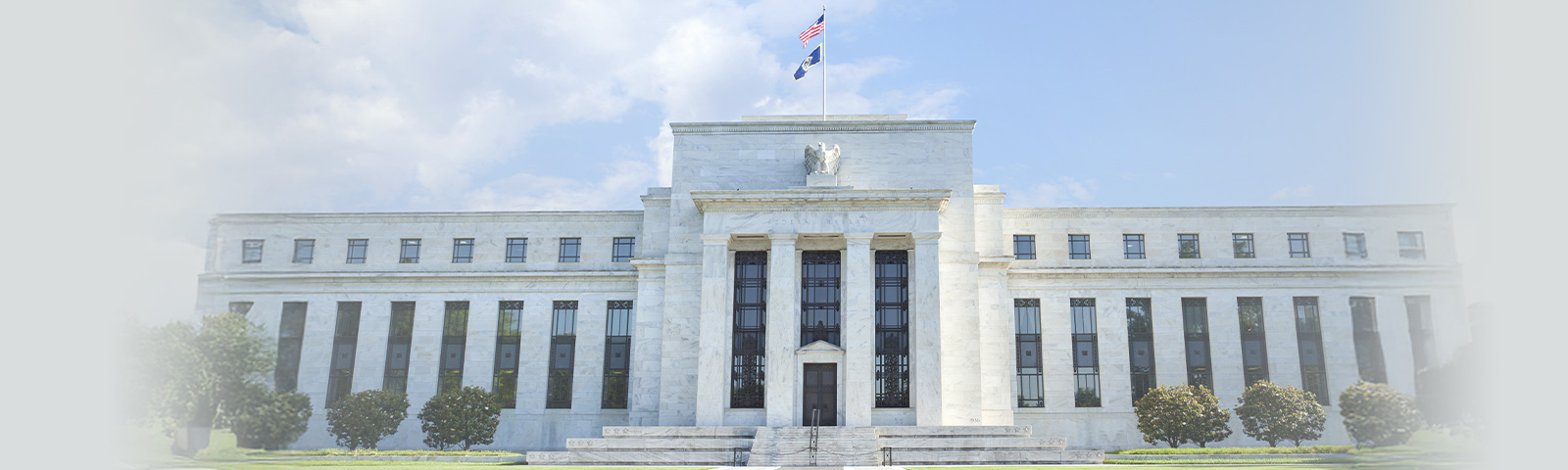
There’s a final twist of irony to leave you with. The Fed building that was at the centre of the now-dropped investigation is the Marriner S Eccles Building in Washington, DC. Just as the administration steps back from probing Eccles’s namesake, Powell seems to have pulled a ‘Marriner Eccles’ on Trump – remaining as a governor to help shield the Fed’s independence.


Your feedback is valuable to us. Did you find this article helpful?
This article is for general information only and it does not constitute an offer, recommendation or solicitation of an offer to enter into any transaction or adopt any hedging, trading or investment strategy, in relation to any securities or other financial instruments. This article has not been prepared for any particular person or class of persons and does not constitute and should not be construed as investment advice or an investment recommendation. It has been prepared without regard to the specific investment objectives, financial situation or particular needs of any person or class of persons. You should seek advice from a licensed or an exempt financial adviser on the suitability of a product for you, taking into account these factors before making a commitment to purchase any product or invest in an investment. In the event that you choose not to seek advice from a licensed or an exempt financial adviser, you should carefully consider whether the product or service described herein is suitable for you.
You are fully responsible for your investment decision, including whether the investment is suitable for you. The products/services involved are not principal-protected and you may lose all or part of your original investment amount.
Standard Chartered Bank (Singapore) Limited will not accept any responsibility or liability of any kind, with respect to the accuracy or completeness of information in this article.
Deposit Insurance Scheme
Singapore dollar deposits of non-bank depositors are insured by the Singapore Deposit Insurance Corporation, for up to S$100,000 in aggregate per depositor per Scheme member by law. For clarity, these investment products are not deposits and do not qualify as an insured deposit under the Singapore Deposit Insurance and Policy Owners’ Protection Schemes Act 2011. Foreign currency deposits, dual currency investments, structured deposits and other investment products are not insured.
The information stated in this article is accurate as at the date of publication.