

Key Takeaways:
- Just as top football managers adjust tactics mid-match in response to changing circumstances, successful investors benefit from a flexible, dynamic approach to their portfolios. Rigid strategies can leave one exposed, being able to pivot keeps you in the game.
- Tactical substitutions and formation shift like those seen in Liverpool’s and Real Madrid’s matches, reflect the importance of regular review and adjustment. Similarly, periodic rebalancing and diversification in investments ensure portfolios remain resilient and capture new opportunities.
- Just as teams use a mix of defensive and offensive tactics to navigate matches, Signature CIO Funds use diversified asset allocation and periodic, disciplined adjustments to balance growth and stability. This ensures your investment portfolio can weather market cycles while remaining ready for unforeseen events.
Table of Contents
Elite football tournaments and long‑term investments often share a critical and inevitable truth: conditions are seldom static. Opposition tactics, player form, and match dynamics frequently force football managers to make real‑time tactical adjustments that can ultimately determine the outcome of a game.
Delivering consistent investment outcomes cannot be achieved through rigid adherence to a pre‑formulated plan as market conditions are consistently evolving. This is where a flexible approach, such as the Signature CIO Funds, becomes important. Designed as a globally diversified, multi‑asset fund‑of‑funds solution, they enable portfolios to respond thoughtfully to changing conditions while remaining aligned with long‑term financial objectives and guided by the expertise of Standard Chartered’s Chief Investment Office.
Why a static investment approach hinders long-term investments
Markets are constantly influenced by factors such as interest rates, inflation, valuations and government policies. As these conditions evolve, a static investment approach may leave portfolios exposed to unanticipated risks or missed opportunities.
When one looks at long-term investments, having a dynamic portfolio allows investors to better manage risk as fixed allocations may result in concentrated risks or potentially diluted returns. A flexible investment framework helps one better navigate uncertainty in the market and preserve capital across cycles.
Football as a live example of a dynamic asset allocation strategy
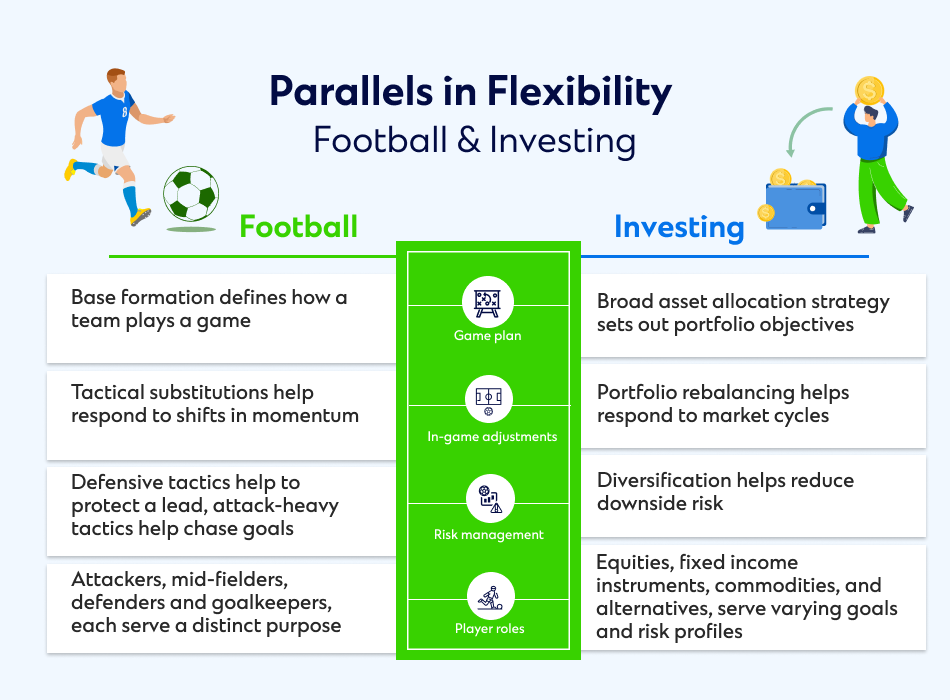
In elite football tournaments such as FIFA and the UEFA Champions League, success is rarely driven by game plans set in stone. Tactical substitutions done in real time respond to ever-changing dynamics, shift in momentum, form, or opposition tactics are essential.
To preserve their lead in a game, a team may choose to switch to more defensive tactics and they may pivot to an attack-heavy strategy if their goal is to score in a game.
Flexibility can influence outcomes. An example of this is Real Madrid’s 3-0 win over RB Salzburg at the FIFA Club World Cup of 2025. Xabi Alonso, Real Madrid’s manager, switched to a five-man defence for the match, instead of opting for the traditional 4-3-3 formation which had been a defining characteristic of the team under managers Carlo Ancelotti and Zinedine Zidane. This tactical adjustment showed results almost immediately, with Real Madrid being able to control the tempo of the match throughout.
Tactical substitutions in investments: Flexible asset allocation and portfolio diversification
While flexibility in investing is essential, it is rarely prudent to abandon or change one’s long-term investment intent. Much like tactical substitutions in football, changes in investment regimes must be made within a clearly defined framework—responding to evolving market conditions while remaining true to one’s objectives.
Regular portfolio review and rebalancing helps ensure one’s asset allocation strategy continues to reflect the changing priorities associated with each of one’s changing life stages and market cycles. With this approach in mind, Signature CIO Funds offers a suite of funds designed to meet varying financial goals, and investment horizons, as well as risk profiles, while allowing for measured flexibility across global capital markets.
Each fund offers diversified exposure across global equities, global bonds, commodities, liquid alternatives, and cash, with allocations varying by fund. Together, these exposures support differing objectives, ranging from capital appreciation and income generation to capital preservation and liquidity.
Signature CIO Conservative Fund
The Signature CIO Conservative Fund’s primary objective is to generate a stable income and ensure capital preservation over a long-term investment horizon. The fund allocates most of its capital to fixed income, money market, and cash, which generally have lower correlation to capital markets and are therefore more resilient during market downturns.
Signature CIO Income Fund
This fund helps investors generate a regular income by investing in a globally diversified portfolio of income-generating securities. To a smaller extent, it also focuses on capital appreciation over a long-term investment horizon by investing mainly in fixed income, equities and hybrids.
Signature CIO Balanced Fund
This fund attempts to provide investors with measured growth via a combination of capital appreciation and a stable income over a mid to long-term investment horizon. The fund invests similar amounts of capital into equities and fixed income instruments, with a slightly heavier tilt towards the former. For additional risk mitigation and portfolio diversification, it also invests a certain amount of capital into commodities and cash.
Signature CIO Growth Fund
The fund seeks to achieve accelerated growth over time, through capital appreciation. It showcases a clear tilt towards equities when it comes to asset allocation, with smaller amounts invested into fixed income instruments, commodities, and alternatives for risk mitigation via portfolio diversification. It is more suited to investors with higher levels of risk tolerance, owing to the volatility levels traditionally associated with equities.
How Signature CIO Funds introduce flexibility into one’s investment portfolio
Each of the four Signature CIO Funds is built around a clearly defined asset allocation framework tailored to different long-term outcomes. Fund managers periodically make disciplined adjustments in response to changing market conditions, while maintaining alignment with each fund’s core investment objectives.
This allows investors to mitigate impending portfolio risks, capture emerging opportunities across asset classes, sectors, and geographies, and prevent any unintended concentration of capital. Furthermore, it also allows one to balance preservation of capital with high liquidity levels, to ensure they have timely access to funds during any unforeseen contingencies such as accidents, illnesses, or even home/vehicular repairs.
Success, whether in football or capital market investments, seldom results from rigid adherence to a singular tactic. Adaptability and timely, measured adjustments; while staying true to one’s original and broader game plan, are what make the difference.
Especially in today’s environment of shifting interest rates, evolving geopolitical developments, and changing market expectations, adaptability has become increasingly important for investors. Signature CIO Funds can help build resilient portfolios across market cycles, whether through a single fund or a thoughtful combination that balances growth and stability.
Keen to introduce flexibility into your investment portfolio? Visit Standard Chartered’s Signature CIO Funds page, or reach out to a Standard Chartered Relationship Manager by using the myRM feature, or our Online Unit Trusts platform via SC Mobile app or Online Banking today.
FAQs on asset allocation
Why is a flexible investment strategy better than a rigid one?
A rigid strategy assumes conditions stay constant, which rarely holds amid shifting interest rates, inflation, and policy changes. A flexible framework, with disciplined, periodic adjustments, allows a portfolio to adapt to changing conditions while staying aligned with long-term goals.
What is portfolio diversification, and how does it reduce risk?
Portfolio diversification means spreading investments across different asset classes, sectors, and geographies, rather than concentrating capital in one area. This can help reduce the impact of a downturn in any single asset class on your overall portfolio.
What are Signature CIO Funds and how do they work?
Signature CIO Funds are a suite of globally diversified, multi-asset fund-of-funds solutions guided by Standard Chartered’s Chief Investment Office. Each fund invests across global equities, bonds, commodities, liquid alternatives, and cash, with allocations that vary depending on the fund’s objective.
How can I choose the right Signature CIO Fund for my risk profile?
The right fund will depend on your risk tolerance, investment horizon, and financial goals. Investors seeking capital preservation and stability may lean toward more conservative allocations, while those with higher risk tolerance and longer horizons may consider funds with a heavier equity tilt.
A good starting point is to spread your money across different types of investments, such as stocks, bonds, commodities, and cash, instead of putting it all in one place. How much you put into each depends on your goals, how long you plan to stay invested, and how comfortable you are with risk. Rather than sticking to a fixed formula forever, it’s worth reviewing your mix regularly and adjusting it as your circumstances or the market changes.


Your feedback is valuable to us. Did you find this article helpful?
This article is for general information only and it does not constitute an offer, recommendation or solicitation of an offer to enter into any transaction or adopt any hedging, trading or investment strategy, in relation to any securities or other financial instruments. This article has not been prepared for any particular person or class of persons and does not constitute and should not be construed as investment advice or an investment recommendation. It has been prepared without regard to the specific investment objectives, financial situation or particular needs of any person or class of persons. You should seek advice from a licensed or an exempt financial adviser on the suitability of a product for you, taking into account these factors before making a commitment to purchase any product or invest in an investment. In the event that you choose not to seek advice from a licensed or an exempt financial adviser, you should carefully consider whether the product or service described herein is suitable for you.
You are fully responsible for your investment decision, including whether the investment is suitable for you. The products/services involved are not principal-protected and you may lose all or part of your original investment amount.
Standard Chartered Bank (Singapore) Limited will not accept any responsibility or liability of any kind, with respect to the accuracy or completeness of information in this article.
Deposit Insurance Scheme
Singapore dollar deposits of non-bank depositors are insured by the Singapore Deposit Insurance Corporation, for up to S$100,000 in aggregate per depositor per Scheme member by law. For clarity, these investment products are not deposits and do not qualify as an insured deposit under the Singapore Deposit Insurance and Policy Owners’ Protection Schemes Act 2011. Foreign currency deposits, dual currency investments, structured deposits and other investment products are not insured.
The information stated in this article is accurate as at the date of publication.