

Key Takeaways:
- Success in tournaments comes from following a well-structured system rather than relying on a single star player. In last team standing, one off day from a star can end the run, just like a portfolio over reliant on a single “hero” asset can get punished when markets turn.
- Squad depth embodies diversification under pressure. Great teams spread responsibility across the pitch, so if one player misfires, others step up. Likewise, disciplined diversification across assets, sectors, and geographies helps a portfolio stay resilient when volatility hits.
- Good managers rebalance instead of panic swapping. Just as coaches adjust tactics during a match, investors should review and rebalance their portfolios rather than react emotionally to sudden headlines
Table of Contents
Last man standing football and capital market investments are both shaped by high stakes and frequent uncertainty. A single mistake on the part of a player (or a team) can end a campaign, the same way a sudden shift in the market, or a single emotional or impulsive reaction to the same, can quickly erode hard-earned returns.
That said, fans and investors alike are often drawn to star players or standout assets, expecting individual brilliance to drive outcomes. Sustained success is built on structure, supported by disciplined systems, clear roles, and adaptability. A football team cannot win with just one player, no matter how talented – in the same way, a resilient portfolio cannot depend on a single asset.
Signature CIO Funds follow a similar philosophy. Active risk management via portfolio diversification, a long-term investment approach, and steady asset allocation practices helps lay the foundations for a portfolio that remains resilient across market cycles.
Asset allocation under pressure: A football lens
In April 2025, global equity markets sold off sharply following the United States’ announcement of a 10% baseline tariff on all countries, alongside higher reciprocal tariffs on selected trading partners.
Closer home, Singapore’s Straits Times Index (STI) plunged 8.57% when trading opened, and it closed 7.5%, the index’s biggest single-day loss since the 2008 global financial crisis.
Such events underscore the uncertainty inherent in capital markets, much like high-stakes football tournaments.
Just as over-reliance on a single player can leave a team vulnerable, a portfolio that is heavily concentrated in one stock, sector, or geography, even one with a strong track record, can face significant losses during market downturns. Resilience—whether in a football tournament or in one’s investment portfolio—comes from disciplined diversification, rather than dependence on the performance of a single asset.
In football and capital markets: Portfolio diversification for uncertain seasons
There is no better example of what diversification can achieve than Liverpool’s decisive 2–0 victory over Real Madrid at Anfield in the 2024–25 UEFA Champions League. The game showcased how a structured, system, rather than reliance on individual brilliance, can drive results. In the days leading up to the match, Mac Allister and Luis Diaz were made part of the team’s starting line-up, in place of Dominik Szoboszlai and Gakpo by head coach Arne Slot.
It was team cohesion, with contributions from across the pitch—Mac Allister’s opener through a quick combination with Bradley, and Gakpo’s (who replaced Nunez in the 68th minute) header, combined with coordinated movement and pressure on the opposing team from Luis Diaz and Curtis Jones, that helped Liverpool seal their win. It was also why Salah’s missed penalty did not deter the team from pressing further either.
Liverpool’s victory demonstrated how structure, flexibility and tactical discipline, rather than reliance on a single star performer, can drive success. The same principle applies to investing, where diversification and disciplined asset allocation help portfolios navigate uncertainty and remain resilient across market cycles.
How Signature CIO funds aid portfolio diversification
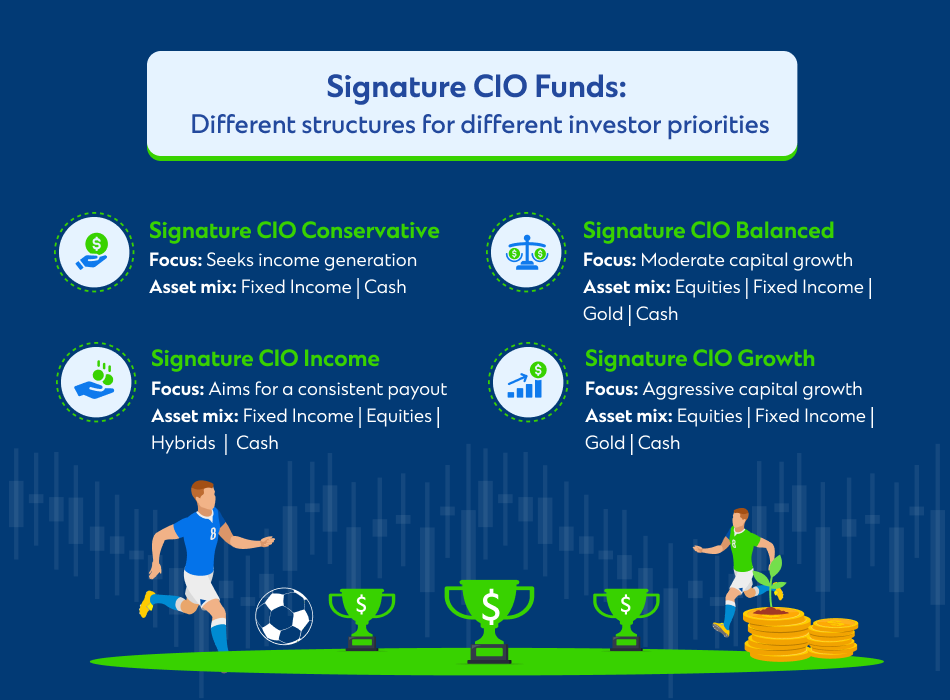
Contributions from across the board via a robust asset allocation strategy and portfolio diversification are precisely what Signature CIO Funds look to achieve. Portfolios are constructed such that they can balance exposure across asset classes, sectors, and geographies, to mitigate risks arising from over-concentration of capital during periods of market volatility.
These funds also allow investors to leverage various sources of return by combining diversified asset classes, including equities, fixed income, ETFs, and alternative strategies. Each fund aims to deliver capital appreciation or a stable income, or a combination of both, based on its own investment objectives, as well as investors’ financial goals.
Signature CIO Conservative Fund
The Signature CIO Conservative Fund seeks to generate income over a mid to long term investment horizon. It has a more defensive asset allocation, with higher exposure to money market funds, fixed income and cash, resulting in a lower risk-to-return profile and greater resilience during market downturns.
The Signature CIO Income Fund
The Signature CIO Income Fund, in contrast, prioritises regular income generation by investing in a diversified portfolio of income generating securities globally. As a secondary objective, it aims to generate capital appreciation over a mid-to-long term investment horizon by accessing opportunities across multiple asset classes.
Signature CIO Balanced Fund
The Signature CIO Balanced Fund seeks to achieve growth through capital appreciation and income accumulation over a mid-to-long-term investment horizon. It has a more balanced asset allocation, with exposure to both equities and fixed income, resulting in a moderate risk-to-return profile.
Signature CIO Growth Fund
The Signature CIO Growth Fund is suitable for investors with a higher risk appetite, focusing on long-term capital growth through a higher exposure to equities, which may experience greater market fluctuations.
The importance of periodically re-assessing asset allocation in one’s portfolio
Much like coaches of elite football teams who continually review and adjust gameplay tactics as tournaments progress, Signature CIO Funds are built and operated on a paradigm of continuously reviewing and rebalancing asset allocation. Portfolio managers actively monitor market conditions and subsequent fund net asset values (NAVs) to rebalance exposure, ensuring funds remain aligned to their core objective of capital appreciation, a stable income, and/or capital preservation. Professional oversight of this nature helps investors navigate uncertain market cycles without over-reliance on any single asset class or sector.
Structure often goes unnoticed when markets are calm, just as a football team’s tactics fade into the background when success appears straightforward. It is only during periods of stress that the value of continuous review, rebalancing, and focusing on the team or portfolio as a cohesive whole becomes clear. In those moments, diversification helps sustain performance and protect long-term goals. The same principles that help football teams navigate injuries, dips in form and changing opposition also underpin the Signature CIO Funds, where diversification, disciplined asset allocation and periodic rebalancing work together to support long-term investing through different market cycles.
Keen to learn more about how to better support your own portfolio’s diversification? Visit Standard Chartered’s Signature CIO Funds page or reach out to a Standard Chartered Relationship Manager by using the myRM feature, or our Online Unit Trusts platform via SC Mobile app or Online Banking today.
FAQs on portfolio diversification
What is portfolio diversification, and why does it matter for investors?
Portfolio diversification means spreading your investments across different asset classes, sectors, and geographies, rather than concentrating all your capital in a single stock or asset. No single investment performs well in every market condition, just as a football team can’t rely on one star player to win every match. Diversification manages this risk, so a downturn in one area doesn’t disproportionately affect your overall portfolio.
What are Signature CIO Funds?
Signature CIO Funds are Standard Chartered’s actively managed investment solutions built on diversification. Each fund draws on a mix of equities, fixed income, ETFs and alternative strategies suited to a specific investment objective, whether that is a balance of growth and income, steady income, capital preservation, or higher long-term growth.
What is the difference between the Signature CIO Conservative, Income, Balanced and Growth Funds?
The four funds are designed for different investor priorities:
- Conservative Fund – Income-focused with lower risk-to-return, allocating more to money market instruments, fixed income, and cash for downturn resilience.
- Income Fund – Prioritises regular income via a diversified global portfolio of income-generating securities, with capital appreciation secondary.
- Balanced Fund – Growth through capital appreciation and income using a balanced equity-fixed income mix. Suited to medium risk-to-return and mid-to-long-term horizons.
- Growth Fund – For higher risk appetite, with greater equity exposure for long-term capital growth, accepting larger short-term fluctuations.
How does multi-asset investing reduce portfolio risk?
A portfolio concentrated in one asset or sector is exposed if that area declines. Markets tend to move in cycles, and no asset outperforms consistently throughout. A diversified portfolio spreads this exposure, so no single area determines the outcome.
How can I find out which Signature CIO Fund suits my portfolio?
The right fund depends on your financial goals, investment horizon, and risk appetite. To explore which Signature CIO Fund may suit your portfolio, visit SC’s Wealth Solutions, or speak with a Standard Chartered Relationship Manager through the myRM feature on Online Banking or the SC Mobile Banking App.


Your feedback is valuable to us. Did you find this article helpful?
This article is for general information only and it does not constitute an offer, recommendation or solicitation of an offer to enter into any transaction or adopt any hedging, trading or investment strategy, in relation to any securities or other financial instruments. This article has not been prepared for any particular person or class of persons and does not constitute and should not be construed as investment advice or an investment recommendation. It has been prepared without regard to the specific investment objectives, financial situation or particular needs of any person or class of persons. You should seek advice from a licensed or an exempt financial adviser on the suitability of a product for you, taking into account these factors before making a commitment to purchase any product or invest in an investment. In the event that you choose not to seek advice from a licensed or an exempt financial adviser, you should carefully consider whether the product or service described herein is suitable for you.
You are fully responsible for your investment decision, including whether the investment is suitable for you. The products/services involved are not principal-protected and you may lose all or part of your original investment amount.
Standard Chartered Bank (Singapore) Limited will not accept any responsibility or liability of any kind, with respect to the accuracy or completeness of information in this article.
Deposit Insurance Scheme
Singapore dollar deposits of non-bank depositors are insured by the Singapore Deposit Insurance Corporation, for up to S$100,000 in aggregate per depositor per Scheme member by law. For clarity, these investment products are not deposits and do not qualify as an insured deposit under the Singapore Deposit Insurance and Policy Owners’ Protection Schemes Act 2011. Foreign currency deposits, dual currency investments, structured deposits and other investment products are not insured.
The information stated in this article is accurate as at the date of publication.